


The Complete Guide to T-Shirt Fabrics for Indian Weather
Cotton, moisture-wicking, antibacterial, and wrinkle-resistant fabrics each handle Indian heat differently. This guide covers which one fits which situation.

The best t-shirt fabrics for Indian weather do three things: move sweat away from skin fast, stay breathable in humidity above 70%, and hold their shape through repeated heat and wash cycles. Weight and weave matter as much as fibre content. A heavy 220 GSM cotton knit traps more heat than a lighter, more open one, regardless of what it's made from.
Most searches for cotton t-shirts for men start here, and for good reason, cotton is the default fabric worth taking seriously first. But it has real limits in sustained humidity, which is why several specific alternatives now exist: cooling synthetic blends, antibacterial cotton hybrids, seamless lightweight knits, and wrinkle-resistant weaves. This guide covers what each of these t-shirt fabrics for Indian weather actually does, where cotton still wins, and which fabric fits which use case.
Is cotton a good fabric for t-shirts in hot weather?
Cotton is breathable, soft against skin, and gentle on sensitive skin in a way most synthetics aren't. This is why it remains the most-searched t-shirt fabric by a wide margin. The fibre itself absorbs moisture well, which is exactly its problem in humidity: cotton holds onto sweat rather than moving it away, so a cotton tee gets heavier and clingier as a hot day goes on, and takes hours to fully dry afterward.
This doesn't make cotton a bad choice among t-shirt fabrics for Indian weather. It makes it a specific one. Plain cotton works well for low-sweat, air-conditioned, or short-exposure situations: an office day, a short commute, an evening out. It becomes a liability in sustained outdoor heat, a workout, or back-to-back wear across a humid day, which is exactly where the fabrics below take over.
A cotton-blend construction changes this calculation. Blending cotton with a plant-derived fibre like Sorona keeps cotton's softness while adding wicking behaviour cotton alone doesn't have. That's the approach behind the Go-To Tee, covered in detail further down.
“In Indian heat, the fibre matters more than the logo.”
— The rule of thumb for choosing t-shirt fabric
What fabric keeps you cool during intense sweat?
Moisture-wicking fabric works on a simple principle: pull sweat away from the skin to the fabric's outer surface, where it evaporates faster than it would sitting against the body. This is what prevents the heavy, clinging feeling of a sweat-soaked cotton tee, keeping it workable rather than saturated.
Cooling fabric goes a step further. ReplyAll's Coolest Tee is made from Temperform™, a ~200 GSM cooling knit of 54% nylon and 46% Coollife® fibre. Its nano-fibres regulate airflow, reducing skin temperature by up to 3°C on contact and keeping your body up to 3°C cooler than the air around you. Nylon itself feels cool against skin before any technology is added, which is why cooling fabrics lean synthetic rather than natural.
ReplyAll describes Coollife® as a nano-technology fibre with a gel component, which is how the Coolest Tee cools on contact and keeps cooling through wear. The fabric is also sweat-wicking and anti-odour.
Construction matters as much as fibre here. The Coolest Tee's raglan shoulders are built for unrestricted shoulder movement, not just fabric performance, which matters for anyone choosing between tees for a workout rather than everyday wear. It's built for training and sport use, but the cooling effect holds up equally well on a hot commute or a day with no air conditioning.
What fabric protects against sun and odour outdoors?
Sustained sun exposure adds a second problem plain cotton doesn't solve: UV exposure and the odour that builds up from bacteria growing in trapped sweat. The Go-To Tee's Breezeknit™ fabric addresses both by blending cotton with Sorona®, a plant-derived fibre that's naturally antibacterial rather than treated with an odour-control finish that washes out over time.
The cotton and Sorona® are blended at yarn level, and the fabric is wrinkle-resistant for hours, though not wrinkle-free, which helps on long days out.
The same fabric carries a UPF 50+ rating, blocking roughly 98% of UV radiation. This is the fabric to reach for on a day with real outdoor exposure: a long walk, a market visit, time on a bike, where both sun and sweat are factors, not just one.
Fit-wise, it's a regular fit, worth knowing if you're comparing it against a boxier or more athletic cut.
What's the lightest t-shirt fabric for extreme heat?
GSM (grams per square metre) measures fabric weight and density. The lower the number, the lighter and more breathable the fabric, generally at some cost to durability. Most everyday tees sit between 160 and 220 GSM. ReplyAll's Lightest Tee uses a 150 GSM, 100% polyester fabric and weighs under 150 grams for the whole tee. It's built on Zeroform™, a seamless, circular-knit construction that ReplyAll says is about 4× lighter than the average active tee.
Seamless here means a circular knit with no side seams, which removes a common friction point during movement. The knit uses a jacquard pattern with larger pores in the places you sweat most, for faster evaporation, and the tee is designed to be anti-chafe and odour-resistant, so it stays comfortable and fresher through runs, workouts and long, humid days.
This is the fabric for the most extreme end of Indian heat: peak summer, direct sun, all-day outdoor movement, where even a good cooling blend still feels heavy. It trades some of the structure a heavier tee holds for the lowest weight ReplyAll makes.
What fabric needs the least ironing?
Not every hot-weather problem is about heat directly. Creasing in humidity, and the time spent ironing it out, is its own daily tax. Wrinkle-resistant fabric is treated or woven to resist creasing under folding and pressure, usually through a resin finish or a fibre blend engineered to spring back to shape rather than hold a crease.
This is different from "wrinkle-free," a term that oversells what most fabrics actually do. Wrinkle-resistant means creasing less and recovering faster, not never creasing at all. ReplyAll's Stepwise Tee is built around this property for everyday wear: pull it from a bag or a drawer and it looks presentable without a pass of the iron, which matters as much on a humid day as breathability does.
The trade-off is that this fabric isn't chasing the extremes the other four are. It's not the coolest, the lightest, or the most sun-protective. It's the one built to look right with the least daily effort, which is its own kind of heat-weather solution.
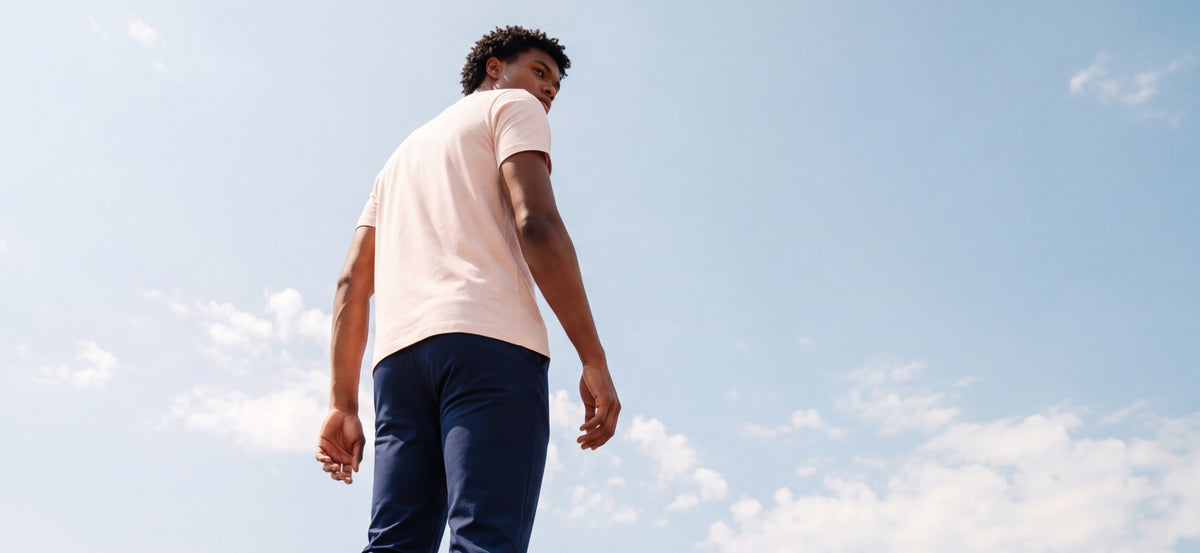
The Go-To Tee in Breezeknit™, with UPF 50+ for days spent outside.
How do you wash performance fabric without ruining it?
Cooling and moisture-wicking finishes are mostly mechanical, built into the fibre or knit structure, so they hold up to normal washing better than people expect, but a few habits shorten their life fast. Fabric softener is the main one: it coats fibres with a residue that blocks the wicking action these fabrics depend on, so it's worth skipping entirely on performance tees, even if you use it on everything else.
High heat is the second culprit. Hot water and high-heat drying degrade the elastane and synthetic blends used in cooling and stretch fabrics over repeated cycles, shortening how long the stretch and cooling effect last. Following the care label helps here: the Coolest Tee, Lightest Tee and Stepwise Tee all call for a cold machine wash and line-drying in the shade, which keeps their cooling and moisture-wicking properties working for longer.
T-shirt fabrics for Indian weather, by use case
Most people need two or three t-shirt fabrics for Indian weather, not one. The right fabric changes with what the day actually involves, not a single best answer.
|
Fabric approach |
Best for |
Key spec |
Trade-off |
ReplyAll pick |
|---|---|---|---|---|
|
Cooling synthetic blend |
Workouts, sustained sweat, peak heat |
Up to 3°C cooler on contact |
Less natural feel than cotton |
|
|
Antibacterial cotton-Sorona blend |
Outdoor exposure, sun, all-day wear |
UPF 50+, ~98% UV block |
Not built for high-intensity sweat |
|
|
Lightweight seamless knit |
Extreme heat, all-day outdoor movement |
Under 150 g per tee, no side seams |
Slimmer, close fit |
The Lightest Tee |
|
Wrinkle-resistant blend |
Low-maintenance everyday wear |
Resists creasing, quick recovery |
Not built for extreme heat or sweat |
|
|
Plain cotton |
Low-sweat, air-conditioned settings |
Soft, breathable at rest |
Holds moisture, slow to dry |
Any cotton-based everyday tee |
Browse the full range in ReplyAll's T-Shirts collection to compare fits and colours across all five.


